
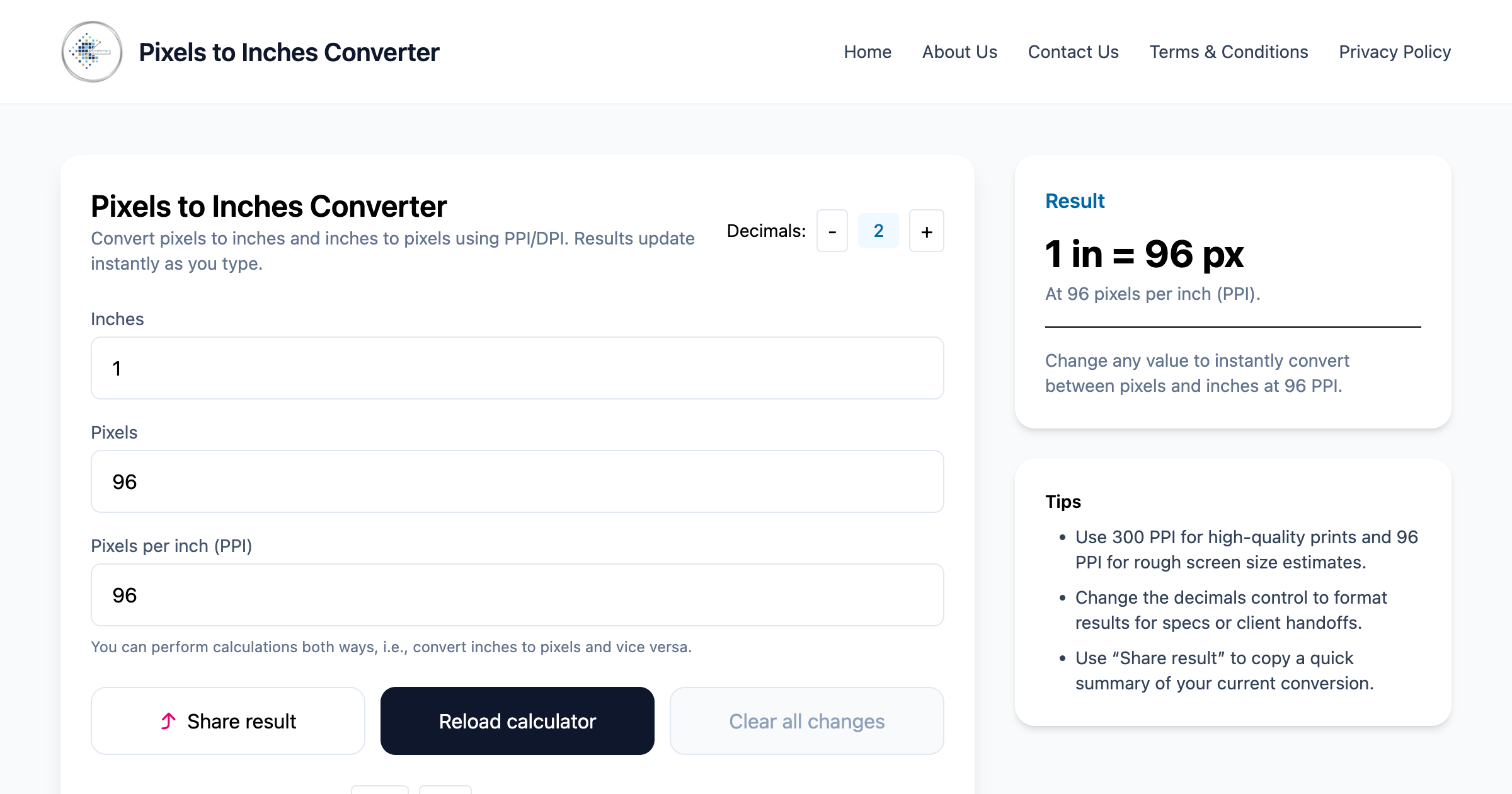
Converting 1224 px to inches requires one additional value: pixels per inch, or PPI. At 72 PPI, 1224 pixels equals 17 inches. At 96 PPI, it equals 12.75 inches. The same pixel measurement becomes 8.16 inches at 150 PPI and 4.08 inches at 300 PPI.
These answers differ because pixels do not have a fixed physical size. PPI determines how many pixels are placed within each inch of an image, screen, or printed output. A higher PPI packs the 1224 pixels into a smaller space, while a lower PPI spreads them across a larger area.
The correct result therefore depends on how the image will be used. A web layout, photo print, poster, and physical display may each require a different interpretation.
Quick Conversion Results
Use the following table to find the physical length represented by 1224 pixels at four common resolutions.
| Pixel Measurement | Resolution | Size in Inches | Size in Centimeters |
|---|---|---|---|
| 1224 px | 72 PPI | 17 in | 43.18 cm |
| 1224 px | 96 PPI | 12.75 in | 32.39 cm |
| 1224 px | 150 PPI | 8.16 in | 20.73 cm |
| 1224 px | 300 PPI | 4.08 in | 10.36 cm |
These results apply to one dimension. If 1224 pixels is the image width, the table gives its width in inches. If it is the height, the table gives its height. You need the other pixel dimension to calculate the complete physical size of the image.
How to Convert 1224 PX to Inches
The conversion formula is:
Inches = Pixels ÷ PPI
For this conversion, the number of pixels remains 1224. Only the PPI value changes.
The general calculation is:
1224 ÷ PPI = length in inches
PPI means pixels per inch. A setting of 300 PPI assigns 300 pixels to every inch. Dividing the total pixel count by the number of pixels used per inch tells you how many inches those pixels can cover.
You can verify the result with the reverse formula:
Pixels = Inches × PPI
For example:
4.08 inches × 300 PPI = 1224 pixels
This reverse calculation confirms that 1224 pixels produces a 4.08-inch measurement at 300 PPI.
1224 Pixels at 72 PPI
At 72 PPI, the calculation is:
1224 ÷ 72 = 17 inches
Therefore, 1224 pixels equals exactly 17 inches at 72 PPI.
Converted into metric units:
-
43.18 centimeters
-
431.8 millimeters
The 72 PPI value has a long history in digital graphics and desktop publishing. It is still found in image metadata, design applications, older templates, and discussions about screen images. However, it should not be treated as the actual pixel density of every modern screen.
An interesting practical connection is US Tabloid paper. Tabloid paper measures 11 × 17 inches. At 72 PPI, its pixel dimensions are 792 × 1224 pixels. This means a 1224-pixel measurement can represent the 17-inch side of a Tabloid page at 72 PPI.
That does not mean every 1224-pixel image is automatically Tabloid size. The image would also need a 792-pixel second dimension and would need to be interpreted at 72 PPI.
1224 Pixels at 96 PPI
At 96 PPI:
1224 ÷ 96 = 12.75 inches
The metric equivalents are:
-
32.385 centimeters, normally rounded to 32.39 cm
-
323.85 millimeters
A 96 PPI conversion is often used for web and CSS measurements because the CSS reference system defines one inch as 96 CSS pixels. Under that relationship, 1224 CSS pixels equals 12.75 CSS inches.
This is a reference conversion, not a promise that an element will measure exactly 12.75 physical inches when you place a ruler against every monitor. Browsers work with CSS pixels, which are logical units. Screen density, device pixel ratio, browser zoom, operating-system scaling, and viewing conditions can change how large an element appears.
For digital layout calculations, 96 PPI gives a useful standardized answer. For a physical print, use the effective PPI required by the printer or print provider instead.
1224 Pixels at 150 PPI
At 150 PPI:
1224 ÷ 150 = 8.16 inches
In metric units, that equals:
-
20.7264 centimeters, rounded to 20.73 cm
-
207.264 millimeters, rounded to 207.26 mm
A resolution of 150 PPI can be suitable for draft prints, posters, signs, and larger materials that will usually be viewed from some distance. Whether it provides enough quality depends on the image content, printing method, viewing distance, and expectations for sharpness.
At this resolution, 1224 pixels can cover twice the physical length it covers at 300 PPI. The tradeoff is that the available pixels are spread farther apart. Fine text, thin lines, and detailed photographic elements may look less sharp when viewed closely.
A 150 PPI target can still be practical when the alternative is heavily enlarging a small source image. It is better to evaluate the actual print from its expected viewing distance than to assume one resolution is suitable for every project.
1224 Pixels at 300 PPI
At 300 PPI:
1224 ÷ 300 = 4.08 inches
The metric equivalents are:
-
10.3632 centimeters, rounded to 10.36 cm
-
103.632 millimeters, rounded to 103.63 mm
A 300 PPI image is commonly used for high-quality photographs, brochures, magazines, product inserts, and other printed materials viewed at close range. At this density, 1224 pixels provide a little more than four inches of print length.
For example, if an image is 1224 pixels wide and 1800 pixels tall, its print dimensions at 300 PPI would be:
Width: 1224 ÷ 300 = 4.08 inches
Height: 1800 ÷ 300 = 6 inches
The resulting print size would be 4.08 × 6 inches before cropping or layout adjustments.
Calling this a “300 DPI image” is common in everyday use. Technically, PPI describes the pixels in the digital image, while DPI describes the dots created by the printer.
Why Does the Inch Measurement Change?
A pixel is a unit of digital image information. It does not have one universal physical length. Its size in inches becomes meaningful only after a pixel density is specified.
Imagine arranging 1224 tiles in a straight row. If you place 72 tiles in every inch, the row covers 17 inches. If you place 300 tiles into each inch, the same number of tiles covers only 4.08 inches.
The number of pixels stays constant in both examples. What changes is their density.
This relationship explains why a digital image can have several valid print sizes. A photo may contain 1224 pixels across one side, but the printer or image editor can assign those pixels to different physical dimensions.
Higher effective PPI generally provides more image samples within each inch. This can produce smoother edges and finer visible detail, provided the source image contains useful detail. Lower effective PPI creates a larger output but gives each inch fewer pixels to reproduce the image.
PPI and DPI Are Related but Not Identical
PPI stands for pixels per inch. It describes the density of pixels in a digital image or physical display.
DPI stands for dots per inch. It describes the density of dots produced by a printer or another output device.
| Measurement | Refers To | Typical Use |
|---|---|---|
| PPI | Digital pixels | Image sizing and display density |
| DPI | Printed dots | Printer output and print settings |
A printer may use several microscopic dots to reproduce the color and tone represented by one image pixel. A printer rated at 1200 DPI does not require an image file at 1200 PPI.
For pixel-to-inch calculations, PPI is the technically correct input because the calculation uses digital pixels. Many calculators and print instructions use DPI informally in place of PPI, so a request for “1224 pixels at 300 DPI” normally means a 300 PPI image sent to a printer. Under that interpretation, the result is 4.08 inches.
What Does 1224 Pixels Mean on a Website?
On the web, 1224 pixels usually describes a layout width, image width, container size, or responsive breakpoint. It does not normally describe a guaranteed physical measurement.
Using the CSS reference relationship:
1224 CSS pixels ÷ 96 = 12.75 CSS inches
However, measuring the result on a physical display may produce a different value. A high-density phone or laptop can use multiple hardware pixels to draw one CSS pixel. Browser zoom can enlarge or reduce the page, while operating-system scaling can change the relationship between interface units and device pixels.
For web design, it is usually more useful to consider:
-
The image’s actual pixel dimensions
-
The maximum width at which it will appear
-
Responsive behavior on smaller screens
-
Device pixel ratio
-
Image compression and file size
-
Whether a higher-resolution source is needed for sharp displays
Changing an image’s metadata from 72 PPI to 300 PPI does not make it look sharper in a browser if its pixel dimensions and displayed size remain unchanged.
Is 1224 Pixels Enough for Printing?
It can be, but the answer depends on the desired print size and viewing conditions.
At 300 PPI, 1224 pixels provides 4.08 inches of print length. This is suitable for a small, detailed print dimension. At 240 PPI, the same measurement becomes:
1224 ÷ 240 = 5.1 inches
At 200 PPI:
1224 ÷ 200 = 6.12 inches
At 150 PPI, it becomes 8.16 inches. That larger output may still look acceptable as a poster or graphic viewed from farther away.
| Target PPI | Maximum Length from 1224 px | General Context |
|---|---|---|
| 100 PPI | 12.24 in | Distant-viewed display |
| 150 PPI | 8.16 in | Poster or draft print |
| 200 PPI | 6.12 in | Moderate print quality |
| 240 PPI | 5.10 in | Good photo output |
| 300 PPI | 4.08 in | Detailed close-viewed print |
These descriptions are general guidance, not fixed quality guarantees. A clean illustration with broad shapes may enlarge better than a photograph with fine texture. Paper, printer quality, sharpening, compression, and viewing distance also affect the result.
Always check the print provider’s requirements before preparing a final file.
Calculating the Full Image Size
A single value such as 1224 pixels reveals only one side of an image. To calculate the complete print dimensions, you need both the width and height.
Assume an image measures 1224 × 1632 pixels.
At 96 PPI:
-
Width: 1224 ÷ 96 = 12.75 inches
-
Height: 1632 ÷ 96 = 17 inches
-
Final size: 12.75 × 17 inches
At 300 PPI:
-
Width: 1224 ÷ 300 = 4.08 inches
-
Height: 1632 ÷ 300 = 5.44 inches
-
Final size: 4.08 × 5.44 inches
The aspect ratio remains the same because both sides are divided by the same PPI value. Problems arise when the width and height are resized independently. Doing so changes the aspect ratio and can stretch or compress the image.
If the required print has a different shape, crop the image or add margins instead of distorting it.
Does Changing the PPI Add More Detail?
Changing only the PPI setting does not change the number of pixels in the file.
A 1224-pixel image remains 1224 pixels whether its metadata says 72 PPI, 96 PPI, or 300 PPI. Adjusting that value without resampling changes the calculated print size:
-
17 inches at 72 PPI
-
12.75 inches at 96 PPI
-
8.16 inches at 150 PPI
-
4.08 inches at 300 PPI
Resampling is a separate process. When resampling is enabled, editing software adds or removes pixels to reach new dimensions. Adding pixels through interpolation can make a file larger, but it cannot perfectly restore detail that was absent from the original.
Before changing resolution in an image editor, check whether the resampling option is enabled. Turn it off if you only want to change the intended print size while preserving the original pixel count.
Common Conversion Mistakes
Leaving Out the PPI
The statement “1224 pixels equals a certain number of inches” is incomplete without a PPI value. Different densities produce different physical sizes.
Using Screen DPI for a Print
A web-oriented 96 PPI calculation gives 12.75 inches, but that does not mean the image will provide detailed 12.75-inch photo output. At 300 PPI, its high-quality print length is only 4.08 inches.
Confusing Metadata with Pixel Dimensions
Changing the resolution field does not necessarily change the image data. Check whether the software is resampling the image.
Assuming CSS Inches Are Physical Inches
CSS uses a standardized relationship between pixels and inches, but screen hardware and scaling can prevent that measurement from matching a ruler.
Calculating Only One Side
A complete image size needs both width and height. Converting 1224 pixels tells you the physical length of only that dimension.
Rounding Too Early
Keep the full result during a calculation and round only the final answer. Early rounding can introduce avoidable errors when several dimensions or unit conversions are involved.
Frequently Asked Questions
How many inches is 1224 pixels?
It depends on the chosen PPI. The measurement is 17 inches at 72 PPI, 12.75 inches at 96 PPI, 8.16 inches at 150 PPI, and 4.08 inches at 300 PPI. Divide 1224 by the intended PPI to calculate the correct size.
Is 1224 px equal to 17 inches?
Yes, but only at 72 PPI. The calculation is 1224 ÷ 72 = 17 inches. At any other pixel density, the physical length changes. For example, the same 1224 pixels equals 4.08 inches at 300 PPI.
What is 1224 px at 300 DPI?
For image-size calculations, a request for 1224 pixels at 300 DPI is usually interpreted as 300 PPI. Divide 1224 by 300 to get 4.08 inches. Technically, PPI describes the digital image, while DPI describes the dots produced by a printer.
How many centimeters is 1224 pixels?
The answer depends on PPI. It equals 43.18 cm at 72 PPI, approximately 32.39 cm at 96 PPI, 20.73 cm at 150 PPI, and 10.36 cm at 300 PPI. First convert pixels to inches, then multiply the result by 2.54.
Can I print 1224 pixels at 8 inches?
Yes. An 8-inch output would have an effective resolution of 153 PPI because 1224 ÷ 8 = 153. Whether that looks good depends on the image, printer, paper, viewing distance, and expected detail. It may work better for a poster than for a close-viewed photograph.
Does 1224 pixels have a fixed physical size?
No. Pixels are digital samples and do not have a universal physical size. They acquire a physical measurement when a PPI value, display density, or output condition is specified. The same 1224 pixels can therefore represent several valid sizes in inches.
What is the formula for converting pixels to inches?
Use inches = pixels ÷ PPI. For example, 1224 pixels divided by 96 PPI equals 12.75 inches. To reverse the calculation, use pixels = inches × PPI.
Will changing 72 PPI to 300 PPI improve the image?
Not if you change only the metadata. The image will still contain 1224 pixels, but its calculated print length will change from 17 inches to 4.08 inches. Resampling can add pixels, but those pixels are estimated and do not guarantee new genuine detail.
Select the Result That Matches Your Output
The correct 1224 px to inches conversion is 17 inches at 72 PPI, 12.75 inches at 96 PPI, 8.16 inches at 150 PPI, or 4.08 inches at 300 PPI. Use 96 PPI for a CSS reference conversion and the required effective PPI for printing. Most importantly, identify the output conditions before treating any one result as the final physical size.